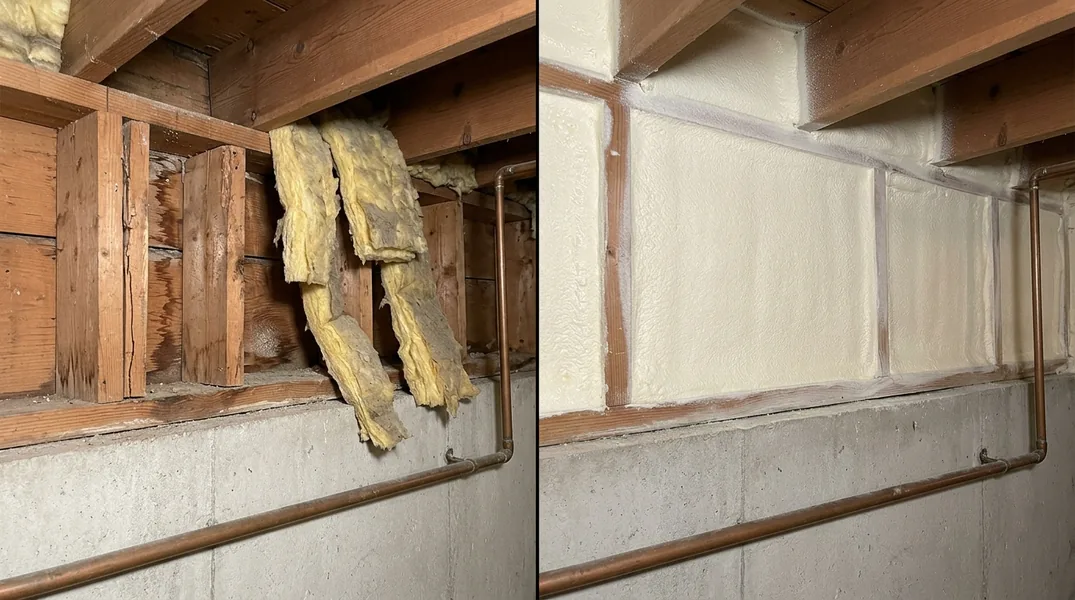
Why Postwar Ranches in Davenport Need Upgraded Insulation
Postwar ranches built across Davenport from the late 1940s through the 1970s represent a significant portion of the area's residential stock. These charming, single-story homes were constructed with the building standards and materials of their era, which means many lack the insulation performance that modern homeowners expect. Back then, a few inches of fiberglass batts in the attic was considered adequate. Today, energy costs are higher, comfort expectations are greater, and our understanding of thermal efficiency has advanced dramatically.
The problem compounds when you consider that these homes were never designed with the tight building envelope standards we see today. Gaps around rim joists, poorly sealed attic spaces, and thin insulation layers allow conditioned air to escape in winter and infiltrate in summer. Attic Spray Foam Insulation addresses both of these critical weak points, sealing air leaks while providing superior R-value performance compared to traditional materials. For homeowners in Davenport looking to improve comfort and reduce utility bills, upgrading these two areas should be the priority.
Spray Foam vs Blown In Insulation: The Key Differences
When comparing spray foam and blown in insulation, the most critical distinction is how they perform at sealing air leaks. Blown in insulation, typically made from cellulose, fiberglass, or mineral wool, excels at filling cavities and providing decent R-value per inch. However, it cannot seal gaps, cracks, or irregular spaces. It works best in uniform cavities where air barriers are already in place. In contrast, spray foam expands as it's applied, conforming to every nook, cranny, and penetration in your attic or rim joist. This expansion creates an air-tight seal that blown in simply cannot match.
The thermal performance difference becomes especially noticeable in older homes. A postwar ranch attic filled with blown in insulation may still experience air leakage around electrical outlets, ductwork, plumbing vents, and the attic access hatch. Spray foam eliminates these thermal bridges by sealing them completely. Additionally, spray foam maintains its R-value over time without settling, whereas blown in materials can compress and lose effectiveness after 10 to 15 years. For homeowners prioritizing long-term energy savings and consistent comfort, spray foam delivers measurably better results than blown in alternatives.
Spray Foam vs Fiberglass: Why Modern Homes Choose Foam
Fiberglass batts and rolls have been the standard attic insulation for decades, and they remain affordable and familiar to most homeowners. However, spray foam vs fiberglass comparisons consistently show that spray foam outperforms in real-world conditions. Fiberglass relies on air pockets within the material itself to resist heat transfer, but it does nothing to prevent air movement around the insulation. A fiberglass-insulated attic can still lose tremendous amounts of conditioned air through gaps, bypasses, and air leaks that fiberglass cannot seal.
Spray foam, whether Closed Cell Spray Foam Insulation or Open Cell Spray Foam Insulation, combines insulation value with air sealing in a single application. Closed cell foam offers higher R-value per inch (typically R-6 to R-7) and provides a vapor barrier, making it ideal for rim joists and attics in humid climates. Open cell foam offers good air sealing with slightly lower R-value (R-3.5 to R-4) but costs less and allows vapor diffusion. Either option will outperform fiberglass in terms of total home energy efficiency because they address both insulation and air leakage simultaneously.
Spray Foam vs Cellulose: Moisture, Settling, and Long-Term Performance
Cellulose is a popular blown in insulation made from recycled paper, and it offers good R-value per inch (around R-3.6). Many homeowners are attracted to cellulose because it's an eco-friendly option and typically costs less than spray foam. However, spray foam vs cellulose reveals significant durability and performance differences. Cellulose is highly susceptible to moisture absorption, which reduces its R-value and can lead to mold growth in humid attics. It also settles over time, losing effectiveness as it compacts. In the humid climate of the Midwest, cellulose requires careful installation and ongoing maintenance to perform reliably.
Spray foam, by contrast, is moisture-resistant and does not settle. Closed cell foam in particular creates a vapor barrier that protects the insulation and the structure beneath it from moisture damage. This matters tremendously in postwar ranches with older roof designs and potential leak points. Once spray foam is installed, homeowners can count on consistent performance year after year without the need for re-fluffing or replacement. For a long-term insulation investment in a Davenport home, spray foam offers superior reliability compared to cellulose.
Best Insulation for Attic: Why Spray Foam Leads the Market
When researching the best insulation for attic spaces, you'll encounter recommendations for fiberglass, blown in cellulose, mineral wool, and spray foam. Each has merits, but spray foam consistently ranks highest among energy-conscious homeowners and professional contractors for several reasons. First, it addresses both the insulation and air sealing needs in a single step. Second, it conforms to irregular attic geometries, including sloped ceilings, trusses, and angled walls common in postwar ranches. Third, it provides a long-term solution that doesn't require replacement or maintenance for decades.
The best insulation for attic is the one that keeps your home comfortable, reduces energy bills, and lasts. Spray foam accomplishes all three. It prevents warm air from escaping in winter and blocks heat infiltration in summer. It performs especially well in attics where air sealing is difficult with traditional insulation. If your postwar ranch attic has visible gaps, poor ventilation, or high utility bills, spray foam is the solution worth considering. To learn more about how spray foam can improve your specific attic, contact Davenport Spray Foam Insulation at (563) 723-0564 or request a free estimate today.
Attic Spray Foam Insulation Cost in Davenport: What to Budget
Homeowners often hesitate to choose spray foam because they assume it costs significantly more than blown in or fiberglass alternatives. While spray foam does have a higher upfront cost per square foot, the total investment must be evaluated in context. Spray foam typically costs between $1.50 and $2.50 per board foot installed, depending on whether you choose open cell or closed cell, and the complexity of your attic layout. Blown in insulation costs roughly $0.50 to $1.50 per square foot, making it appear cheaper initially. However, this comparison ignores the air sealing benefits spray foam provides and the energy savings that accumulate over time.
When you calculate the long-term return on investment, spray foam often pays for itself within 5 to 7 years through reduced heating and cooling costs. Many homeowners also find that improved comfort and reduced noise from air infiltration add value beyond energy savings alone. If you're planning to stay in your postwar ranch home long-term, spray foam is a smart financial decision. For accurate pricing tailored to your attic and rim joist needs, reach out to Davenport Spray Foam Insulation. We'll assess your home and provide a transparent quote so you can make an informed decision.
Looking for a professional spray foam insulation contractor in Davenport? Davenport Spray Foam Insulation responds fast for all your spray foam insulation needs.
Get a Free Quote