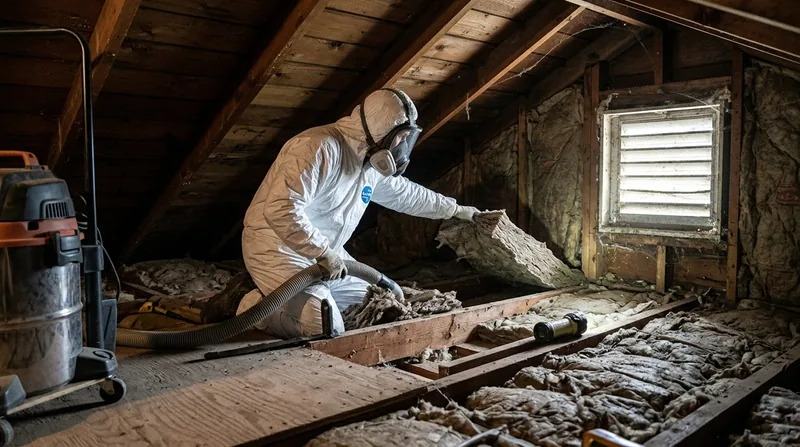




Davenport's housing stock tells a story of moisture and time. Nineteenth-century homes near the Mississippi River, postwar ranches with flattened attic insulation, and older Bettendorf and Eldridge subdivisions all carry insulation that has settled, absorbed humidity, or simply failed to perform. Insulation removal in Davenport is often the essential first step before new spray foam or blown-in insulation can do its job. We remove old fiberglass, cellulose, and deteriorated insulation from attics, walls, and crawl spaces across Greater Davenport, clearing the way for a clean, code-compliant reinstallation. The river valley's cold winters and humid summers make this work critical: wet, compressed insulation loses R-value and traps moisture against framing. A proper removal followed by new foam or blown-in insulation restores thermal control and stops the air leaks that drive heating and cooling costs year-round.
Why Old Insulation Fails in Davenport's River-Valley Homes
Davenport sits in IECC climate zone 5A, where cold winters push moisture outward through walls and roofs while hot, humid summers pull it back in. Older fiberglass insulation settles under its own weight, compressing from an original R-19 to an effective R-8 or less over decades. Cellulose absorbs moisture and becomes a heavy, ineffective mass. In homes near the river and in East Davenport's historic neighborhoods, balloon-framed walls and uninsulated rim joists above damp basements create cold floors and ice dams in winter. Postwar ranches across Davenport often have vented attics where the original fiberglass has flattened completely, leaving gaps where air escapes freely. Removal clears out the failed material so new insulation can seal air leaks, control moisture, and restore the R-value the home needs.
- Flattened fiberglass loses half or more of its R-value over 30 to 50 years of settlement and humidity exposure.
- Cellulose insulation in older Davenport attics absorbs water from humid summers and becomes matted and heavy, losing insulating power.
- Contaminated or rodent-damaged insulation must be removed before new material can be installed safely and cleanly.
- Air leaks around old insulation batts and blown-in material remain unaddressed unless the old material comes out and foam or sealed air barriers go in.
- Moisture trapped in compressed insulation promotes mold growth on framing and reduces the lifespan of the assembly.
Removing old insulation is not optional when the material has failed; it is the foundation of any retrofit that works.
Key info: A 1950s ranch in Davenport with original fiberglass in the attic often shows R-values of R-5 to R-8 where R-30 or R-38 is needed. Removal and replacement with closed-cell spray foam or blown-in fiberglass restores thermal control and stops the ice dams that plague older homes in the heating season.
For guidance on what applies at your address, visit the City of Davenport Planning and Zoning Department or your local building official to confirm whether your project requires a permit or notification.
How We Remove Old Insulation in Davenport and Bettendorf
Removal begins with a site assessment. We identify the type of insulation (fiberglass, cellulose, or old foam), its condition, any moisture or contamination, and access points. We set up containment and mechanical ventilation to control dust and odors during removal. The old material is carefully extracted, bagged, and disposed of responsibly. Once the attic or wall cavity is clean and dry, we inspect framing for damage, seal air leaks, and prepare the substrate for new insulation. This process protects your home's structure and ensures new insulation performs as designed. Insulation replacement and re-insulation follows the same careful sequence.
- We assess the type, depth, and condition of existing insulation before any removal begins.
- Mechanical ventilation and containment protect indoor air quality during the removal process.
- Old material is bagged, labeled, and disposed of at a licensed waste facility.
- We inspect framing for rot, pest damage, or moisture before new insulation is installed.
- Air sealing and moisture control are completed before new foam or blown-in material goes in.
- New insulation is installed to manufacturer specifications and local building code requirements.
A complete removal and replacement job in an attic typically takes one to two days, depending on square footage and access.
Example: A 1,200-square-foot attic in Eldridge with settled fiberglass and moisture damage takes approximately six to eight hours for removal, inspection, and air sealing. New closed-cell spray foam is then applied in a second visit, creating a sealed attic that stops heat loss and controls humidity year-round.
Learn more about the insulation methods best suited to your project by exploring closed-cell spray foam insulation and open-cell spray foam insulation options.
Removal Methods and When Each One Works Best
| Method | Description | Best For |
|---|---|---|
| Manual removal with containment | Hand removal of batts and blown-in material using sealed bags and mechanical ventilation to control dust. | Fiberglass batts, cellulose, and light accumulation in attics and walls where access is adequate. |
| Vacuum extraction | Powered vacuum system draws loose blown-in insulation into sealed collection bags with HEPA filtration. | Blown-in fiberglass or cellulose in large attics where manual bagging would be time-prohibitive. |
| Foam removal and substrate prep | Mechanical removal of existing spray foam, inspection of the substrate, repair of damage, and cleaning before new foam is applied. | Attics or walls with failed or poorly installed spray foam that requires complete replacement. |
| Selective removal and top-up | Removal of damaged insulation in localized areas with retention of sound material, followed by new insulation in gaps. | Attics where only portions of insulation are wet or compressed, and the remainder is in acceptable condition. |
Each removal method is chosen based on the material type, the extent of damage, and the layout of the space. We discuss the right approach during the free estimate.
Insulation Removal Cost in Davenport: What to Expect
The cost of insulation removal in Davenport ranges from $950 to $2,500 for a typical attic, depending on the size of the space, the type and depth of insulation, and the complexity of disposal. A small attic (under 800 square feet) with settled fiberglass may run $950 to $1,200. A larger attic (1,200 to 1,600 square feet) with mixed materials and moisture damage typically costs $1,400 to $2,000. Wall cavity removal or crawl space insulation removal is priced by the linear foot or square foot and requires a site visit to quote accurately. Access difficulty, the presence of contamination, and the need for framing repair all affect the final cost. The best way to understand pricing for your home is to review our pricing overview and request a free estimate at (563) 723-0564.
Why get a written estimate before removal? Because the actual condition of the insulation, framing, and ventilation system can only be determined on site. A professional estimate includes the scope of removal, disposal, any framing repairs, air sealing work, and the new insulation method recommended for your home's climate zone and building code. We provide written estimates with R-value and thickness specifications so you know exactly what you are paying for and what the finished product will deliver.
What to Look for When Hiring an Insulation Removal Contractor Near Davenport
Not all insulation contractors are equal. The difference between a professional removal and a rushed job is visible in the estimate itself. A reputable contractor provides a written breakdown of labor, materials, disposal, and new insulation specifications. They explain the condition of your current insulation and why removal is necessary. They discuss ventilation requirements, building code compliance, and permits if they apply to your address. They carry full insurance and can provide proof of coverage. They do not promise a price without seeing the job, and they do not guarantee energy savings as a percentage or dollar amount. They answer questions about their process, timeline, and cleanup without pressure or dismissal.
- Request a written estimate that names the type of insulation being removed and the R-value and thickness of the new material.
- Ask whether the contractor carries full insurance and request proof of coverage before work begins.
- Verify that the contractor understands local permitting requirements by asking how they handle notifications to the building department.
- Check references from recent jobs in Davenport or nearby areas such as Bettendorf, Eldridge, or Blue Grass.
- Confirm that mechanical ventilation and containment are used during removal to protect indoor air quality.
- Understand the re-entry window after new spray foam is applied, typically 24 to 48 hours depending on the product and cure conditions.
A contractor who can explain the removal process, discuss moisture control, and recommend the right insulation method for your climate zone is the one to hire. Contact us for a free estimate and a straightforward conversation about your insulation needs.
Insulation Removal in Davenport: Pricing Guide
| Service | Price | Details |
|---|---|---|
| Small attic removal (under 800 sq ft) | Starting at $950 | Settled fiberglass or light cellulose, basic disposal, includes air sealing prep for new insulation |
| Standard attic removal (800 to 1,200 sq ft) | Starting at $1,200 | Moderate depth, mixed materials, moisture assessment, framing inspection, disposal and ventilation setup |
| Large or complex attic (over 1,200 sq ft or multiple zones) | Starting at $1,500 | Vacuum extraction, contamination handling, extensive framing repair, multiple access points, full site cleanup |
| Wall cavity or crawl space removal | On estimate | Requires site visit to assess access, linear footage, material type, and structural complexity before pricing |
| Travel and site assessment | Included | No mileage fee or travel charge in Davenport, Bettendorf, Eldridge, and surrounding service areas |
| Free written estimate | No obligation | Response within 24 hours at (563) 723-0564, includes R-value and thickness specifications for new material |
Indicative pricing, the exact cost depends on square footage, finish, and site access. Free personalized estimate within 24h at (563) 723-0564.


