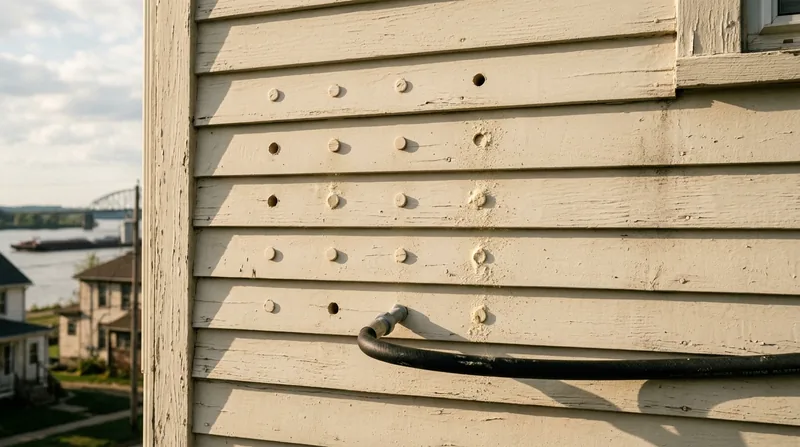




Wall & Injection Foam Insulation in Davenport solves a problem unique to this city's housing stock: nineteenth-century and early-1900s homes built with balloon frames and uninsulated stud cavities, now sitting behind plaster and lath that homeowners want to keep. Davenport's river-valley climate, with cold winters driving heat loss and humid summers pushing moisture into walls, makes those hidden cavities a chronic source of drafts and energy waste. Injection foam reaches into closed walls without demolition, filling the voids that fiberglass batts and blown-in insulation cannot touch. This is not a cosmetic upgrade, it is a structural retrofit that stops the air leakage pattern that defines older Davenport homes. We inject closed-cell or open-cell foam into stud bays from the exterior or interior, sealing the cavity completely and restoring the thermal envelope of homes that were built before modern insulation standards existed.
Why Wall Injection Foam Matters in Davenport's Historic Neighborhoods
Davenport's Village of East Davenport and the neighborhoods near the Mississippi River are filled with homes built between 1890 and 1930, when insulation was either nonexistent or a thin layer of sawdust or newspaper. These homes sit above full basements, have exterior walls exposed to river-valley wind and moisture, and were designed before anyone thought about air sealing. The stud cavities in these walls are open to the attic above, creating a continuous thermal leak that no amount of attic insulation can fix. Winter heating loss runs straight up through the walls, and summer humidity migrates inward, leaving those basements damp and the upstairs rooms cold. Injection foam stops that leakage without requiring you to tear out the plaster, lath, or exterior siding that gives these homes their character.
- We drill small holes through the exterior sheathing or interior drywall and inject foam into each stud bay, filling the entire cavity in one pass.
- The foam expands to seal air gaps, gaps around old wiring and plumbing, and the spaces where the top plate meets the roof framing.
- Closed-cell foam adds structural rigidity and provides a vapor barrier, critical in Davenport's humid climate where moisture moves outward in winter.
- Open-cell foam is less expensive and still stops air leakage, though it requires a separate vapor barrier in cold climates like zone 5A.
- Injection foam works on homes with existing insulation, adding R-value without removing what is already there.
- The process takes one to three days depending on wall area and is less disruptive than removing siding or drywall.
The result is a home that stays warmer in winter, cooler in summer, and dry year-round, with no loss of interior or exterior finishes.
Key info: Homes built before 1950 in Davenport often have balloon-frame walls that run continuously from basement to attic, meaning heat escapes up through the walls even if the attic is insulated. Injection foam seals that entire pathway in one retrofit, something no other insulation method can do without demolition.
How Wall Injection Foam Works: The Davenport Process
We start with a written estimate that includes the square footage of wall area, the R-value and thickness of foam we propose, and the cost per board foot. Unlike generic contractors who quote a price and disappear, we specify exactly what goes into your walls. We then drill access holes (typically 2 inches in diameter) through the rim, band joist, or exterior sheathing at intervals of 16 to 24 inches, matching the stud spacing. A hose is inserted into each cavity and foam is injected under pressure, filling from the bottom of the wall upward. The foam expands and hardens, bonding to the studs, sheathing, and any existing insulation. Once cured (typically 24 to 48 hours), the holes are plugged, sanded, and finished to match your wall. If exterior holes were drilled, they are sealed with caulk or foam and painted. Interior holes in basements or crawl spaces are simply plugged with foam and left as is.
- We inspect the wall cavity, check for moisture, active leaks, or contamination, and walk away if the substrate is not dry enough for foam.
- We drill access holes at the proper intervals and insert foam delivery hoses into each cavity.
- We inject closed-cell or open-cell foam at the manufacturer's specified ratio and temperature, monitoring pressure to avoid over-filling.
- The foam expands to fill the cavity completely, sealing air gaps, electrical outlets, and rim-to-band transitions.
- We allow the foam to cure per the manufacturer's window, typically 24 to 48 hours, before disturbing it.
- We plug all access holes with matching foam or caulk and finish the wall to your specification.
The entire process is contained and does not require interior demolition, making it the only retrofit option for homes where keeping the original finishes matters.
Example: A 1910 home in East Davenport with a 40-foot exterior wall, 8 feet tall, and 16-inch stud spacing requires about 20 access holes and 80 to 100 board feet of closed-cell foam. The job takes two days on site, the wall is sealed and insulated to R-20 or higher, and the plaster and exterior brick are never touched.
For homes with rim joist and band joist leaks, injection foam is often the first step in a larger air sealing strategy that also covers attic spray foam insulation and top-plate sealing.
Wall Injection Foam Methods and Materials
| Approach | Description | Best For |
|---|---|---|
| Closed-Cell Injection Foam | High-density foam (2 to 2.5 lbs/cu ft) that expands minimally and creates a vapor barrier. R-value 6 to 6.5 per inch. Resists moisture and provides structural stiffness. | Exterior walls in cold climates, basement walls prone to moisture, rim joists, and homes where vapor control is critical. |
| Open-Cell Injection Foam | Lower-density foam (0.5 to 1 lbs/cu ft) that expands fully and is permeable to vapor. R-value 3.5 to 3.7 per inch. Lower cost, allows drying if moisture enters. | Interior walls, basements with stable moisture, and budgets where R-value per inch matters less than air sealing. |
| Exterior Injection (Rim and Band) | Holes drilled through rim board or rim sheathing from the outside, foam injected from above. Most common retrofit method in Davenport. | Homes with accessible foundations, basements above grade, and projects where interior walls must remain undisturbed. |
| Interior Injection (Basement or Crawl) | Holes drilled through interior drywall or band joist from inside, foam injected and holes plugged. Requires access to basement or crawl space. | Homes where exterior access is blocked, finished basements, and jobs where drilling the exterior finish is not acceptable. |
| Cavity-Fill Over Existing Insulation | Injection foam added on top of or beside old fiberglass, mineral wool, or cellulose without removal. Seals gaps and voids in the existing layer. | Retrofit jobs where removal cost is prohibitive, walls with settled or compressed insulation, and fast upgrades to existing homes. |
Wall & Injection Foam Insulation Cost in Davenport: What to Expect
Wall injection foam typically costs starting at $2 per square foot of wall area treated, though the final price depends on the cavity depth, foam type, accessibility, and whether holes are drilled from the exterior or interior. A 40-foot exterior wall, 8 feet tall, and fully injected with closed-cell foam runs roughly $640 to $800 before finishing. Open-cell injection costs less per board foot but requires more material to reach the same R-value. Access matters: if the rim is easy to reach from outside, the job moves faster. If you must drill through finished siding or interior drywall and patch afterward, labor and materials rise. Existing insulation in the cavity does not stop injection foam, but it slows the process slightly because the foam must fill around it.
The best way to understand your cost is to request a written estimate with R-value and thickness specified. We measure the wall area on site, specify the foam type and depth, calculate the board footage, and give you a fixed price before we start. Two or three estimates from different contractors will show you the range in your area and help you spot low-ball quotes that skip important details like thickness, R-value, or proper ventilation during cure.
For a detailed breakdown of pricing across all our services, see our full pricing page. If you want to move forward, contact us for a free estimate and we will schedule a site visit within 24 hours.
What to Look for When Hiring a Wall Injection Foam Contractor Near Davenport
Hiring a spray foam contractor is not like hiring a painter or a roofer, because the material is applied under pressure and the installation method directly affects performance and safety. A bad injection job leaves voids, over-fills cavities and cracks drywall, or is done so fast that the foam never cures properly, leaving a smell that lingers for weeks. The best way to protect yourself is to ask the right questions and get multiple estimates. Verify that the contractor carries full insurance and ask to see a certificate before work begins. Confirm that the estimate includes R-value and foam thickness, not just a price per square foot. Ask how long the foam takes to cure and what your re-entry window is (typically 24 to 48 hours for full cure). Check references from past jobs in Davenport or nearby towns like Bettendorf, Eldridge, or Blue Grass, and call at least two to ask about smell, timeline, and whether the contractor was reachable if problems came up later.
- Ask for a written estimate that lists the foam type (closed-cell or open-cell), R-value per inch, and total thickness you will receive in each cavity.
- Verify that the contractor uses mechanical ventilation during foam cure and specifies a 24 to 48 hour re-entry window before you occupy the space.
- Request references from at least two jobs completed in the last two years in Greater Davenport and call them to ask about the contractor's responsiveness and the quality of the finished work.
- Confirm that the estimate includes all patching, caulking, and finishing of access holes, not just the foam injection.
- Ask about the contractor's insurance coverage and request a certificate of insurance naming you as an additional insured during the work.
- Check whether the city or county requires a permit for wall injection work at your address by contacting your local building department before you book.
The contractor who gives you the lowest price and the shortest timeline is usually the one who will cut corners on ventilation, thickness, or finishing. Davenport's climate and your home's age demand proper installation, and the cost difference between a good job and a cheap job is often only a few hundred dollars, but the difference in performance and longevity is years.
Ready to get started? Contact us for a free, no-obligation estimate or call (563) 723-0564 to discuss your wall and injection foam needs.
Wall & Injection Foam Insulation in Davenport: Pricing Guide
| Service | Price | Details |
|---|---|---|
| Wall Injection Foam, Closed-Cell | Starting at $2/sq ft | Includes drilling, foam injection at manufacturer specs, cavity filling, and hole patching. Price increases with wall height, accessibility, and exterior finish type |
| Wall Injection Foam, Open-Cell | Starting at $1.50/sq ft | Lower cost than closed-cell, still seals air leaks completely. Requires separate vapor barrier in cold climates. Best for interior or stable-moisture walls |
| Rim Joist and Band Joist Injection | Starting at $2.50/sq ft | Exterior or interior access, closed-cell foam to resist moisture. Includes drilling, injection, patching, and caulking all penetrations |
| Cavity Fill Over Existing Insulation | Starting at $1.75/sq ft | Injection foam added to walls with old fiberglass, mineral wool, or cellulose. No removal required, fills gaps and voids in settled layers |
| Travel and Estimate | Included and Free | No mileage charge within Davenport and service areas. Written estimate with R-value and thickness specs provided within 24 hours of site visit |
Indicative pricing, the exact cost depends on square footage, finish, and site access. Free personalized estimate within 24h at (563) 723-0564.


