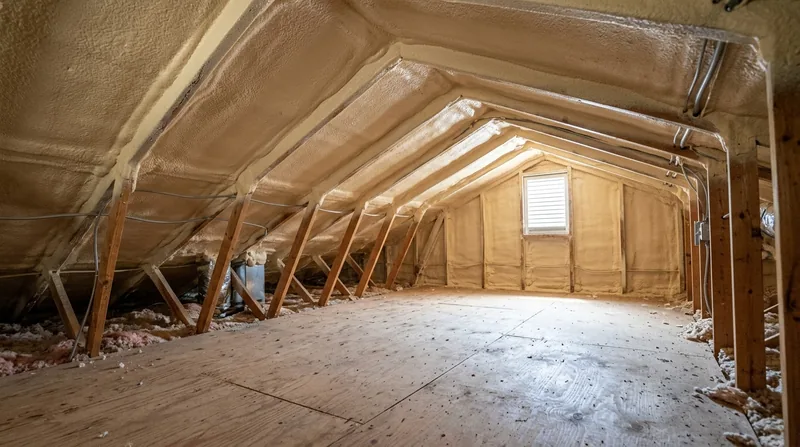




Attic spray foam insulation in Davenport stops the heat loss that drives energy bills up in postwar ranch homes across Scott County. Davenport sits in IECC climate zone 5A, where cold winters push heated air straight through uninsulated attic spaces and vented roof decks, and humid summers pull moisture into those same cavities. The typical Davenport attic loses conditioning fast because the original insulation has flattened, and the roof deck itself carries no thermal break. We spray closed-cell or open-cell foam directly to the underside of the roof deck to create a conditioned attic that blocks winter drafts and summer heat gain. The result is a sealed, insulated envelope that stops air leakage at the source, not just adds R-value on top of a leaky frame.
Why Attic Spray Foam Insulation Matters in Davenport's Cold, Humid Climate
Davenport's location along the Mississippi River and its exposure to cold winters and humid summers create a specific insulation problem: heat loss in winter and moisture infiltration year-round. Postwar ranch homes with vented attics and original fiberglass insulation lose conditioning through the roof deck because the insulation sits on the attic floor, not on the deck itself. The air gap between the insulation and the underside of the roof shingles allows warm air to rise, meet the cold roof surface, and escape through every seam and penetration. Spray foam on the roof deck eliminates that gap and the air movement that causes the loss.
- Seals air leaks at the roof deck where vented attics lose the most heating and cooling energy.
- Creates a conditioned attic space that stays closer to indoor temperature and reduces the load on HVAC equipment.
- Controls moisture movement during humid summers by stopping the inward vapor drive that causes condensation on cold basement walls and rim joists.
- Works in older balloon-framed homes near East Davenport where uninsulated cavities above basements have never been sealed.
- Provides thermal continuity across the entire roof assembly, not just between the rafters.
Spray foam on the roof deck is the most effective way to condition an attic because it addresses the root cause of the heat loss: air leakage and the vented cavity itself.
Local example: A 1960s ranch in Bettendorf with a vented attic and 4 inches of settled fiberglass loses heat through the roof deck and rim joists because the insulation no longer touches the framing. Spray foam to the roof deck seals the deck itself and stops the loss. The same home in Eldridge with a newer two-story and conditioned attic space still leaks at penetrations, ductwork, and the top plate, which spray foam and air sealing address directly.
For more detail on how spray foam controls moisture and insulates in cold climates, see our guide to closed-cell spray foam insulation, the product of choice for roof decks and moisture-prone spaces.
How We Install Attic Spray Foam Insulation in Davenport: The Process
Attic spray foam installation starts with a clear understanding of what the roof deck needs: R-value, thermal barrier compliance, and air sealing. We inspect the attic to identify air leaks, existing insulation condition, and any moisture or ventilation issues. If the space is wet, contaminated, or actively leaking, we stop and refer you to the appropriate contractor, because spray foam over a compromised substrate does not fix the problem. Once the space is dry and ready, we mask off HVAC ducts, electrical boxes, and any areas that must stay clear. We then spray the foam in controlled passes to the specified thickness, maintain the proper drum temperature and mix ratio, and ensure mechanical ventilation runs throughout the cure period.
- We inspect the attic and measure existing insulation, air leaks, and structural condition before quoting.
- We identify and refer any moisture, roof leaks, or contamination issues rather than spray over them.
- We mask electrical boxes, HVAC equipment, and soffit vents to maintain code compliance and prevent overspray.
- We spray foam in multiple controlled passes at the thickness and R-value specified in the estimate.
- We run mechanical ventilation during cure and enforce a twenty-four to forty-eight hour re-entry window before the space is occupied.
- We provide a written warranty on the installation workmanship for one year.
The entire process from inspection to cure takes two to three days, depending on attic size and the number of passes required to reach the target R-value.
Davenport example: A 1,600-square-foot ranch attic in Davenport 52806 with original 4-inch fiberglass and significant air leakage at the roof deck and rim joist requires 5.5 inches of closed-cell foam to reach R-38 and seal the deck. The job takes one day to spray, with ventilation running for twenty-four hours. The homeowner re-enters after that window and the space is conditioned immediately. A larger two-story in Bettendorf with a 2,400-square-foot attic and a sealed roof deck may need only 3 inches of open-cell foam to reach R-21 and improve air sealing at penetrations, a smaller job with lower cost.
For information on how we handle air sealing around penetrations and rim joists, see our dedicated air sealing page.
| Approach | Description | Best for |
|---|---|---|
| Closed-cell foam to roof deck | High-density foam sprayed 5 to 6 inches thick, R-6 per inch, with integral vapor barrier and moisture resistance. | Vented attics in zone 5A, humid climates, rim joists, and any space where moisture control is critical. |
| Open-cell foam to roof deck | Low-density foam sprayed 5.5 to 7 inches thick, R-3.5 per inch, with sound dampening and lower cost per board foot. | Conditioned attics, sound control, and budgets that require lower initial cost with acceptable R-value. |
| Foam plus blown-in fiberglass top-up | Spray 2 to 3 inches of foam to the roof deck for air sealing, then blown-in fiberglass on top to reach target R-value at lower cost. | Attics that need air sealing but already have good insulation depth, or budgets that require a two-stage approach. |
| Rim joist and band joist sealing | Closed-cell foam sprayed to the rim and band joists above basement or crawl space walls, 2 to 3 inches thick. | Cold basements, moisture control, and eliminating the thermal bridge where basement walls meet the conditioned floor above. |
Attic Spray Foam Insulation Cost in Davenport: What to Expect
Attic spray foam insulation in Davenport starts at $1.50 per square foot for basic open-cell foam applied to the roof deck, and ranges up to $2.50 or more per square foot for closed-cell foam with full air sealing and multiple passes. The final cost depends on the attic size, the existing insulation condition, the target R-value, and whether the space requires moisture remediation before foam can be applied. A 1,200-square-foot attic needing 5 inches of closed-cell foam to reach R-30 will cost more than a 1,200-square-foot space that needs only 3 inches of open-cell foam for air sealing plus a top-up of blown-in insulation. Access, the number of penetrations to seal, and the complexity of the roof assembly also move the price up or down.
The best way to know your actual cost is to get written estimates from two or three contractors, each showing the R-value, thickness, product type, and square footage being insulated. Do not rely on phone quotes or online calculators, because spray foam is measured on site and priced by the board foot, not by a fixed rate per square foot. A contractor who quotes you a price without visiting the attic is guessing, and that guess will not match the final invoice.
Cost example: A 1,600-square-foot ranch attic in Davenport needing 5.5 inches of closed-cell foam to reach R-38 costs between $2,400 and $3,200 depending on access, existing insulation removal, and air sealing scope. A 2,400-square-foot attic in Eldridge needing only 3 inches of open-cell foam plus 2 inches of blown-in fiberglass costs $1,800 to $2,400. The difference reflects product cost, labor, and the scope of air sealing required.
For a detailed breakdown of pricing across all our services, visit our pricing page. Call us at (563) 723-0564 to schedule a free estimate with R-value and thickness specifications included.
Attic Spray Foam Insulation Near Me: What Davenport Homeowners Should Know When Hiring
Hiring the right spray foam contractor matters because the installation quality determines whether the foam will perform as designed and whether the space will be safe to re-enter on schedule. The spray foam trade includes reputable local shops, national franchises, and rig-and-run crews that spray a job in an afternoon and disappear when the smell will not go away or the foam fails. Before you hire, verify that the contractor is fully insured, get a written estimate that specifies R-value and thickness, and ask for references from recent jobs in Davenport or nearby areas. Check whether the contractor's estimate includes the re-entry window and post-cure ventilation, because those details separate a professional installation from a rushed one.
- Ask the contractor to show proof of current insurance coverage and provide the name and number of their insurance agent if you want to verify it.
- Request a written estimate that lists R-value, foam thickness in inches, square footage, product type (open-cell or closed-cell), and the total cost broken down by labor and materials.
- Call or email at least two other contractors in Davenport or Bettendorf and ask the same questions to compare scope and price.
- Ask for three to five references from homeowners in Davenport, Eldridge, or Riverdale who had attic foam installed in the last two years.
- Confirm that the contractor will run mechanical ventilation during the cure period and will not allow re-entry until the specified window (twenty-four to forty-eight hours) has passed.
- Ask whether the local building department requires a permit for attic insulation in your city, and whether the contractor will help you navigate that requirement.
- If your home is in an HOA, check the architectural guidelines to see whether exterior work on the roof or fascia requires approval before the job starts.
A contractor who rushes the estimate, promises immediate re-entry, or quotes a price far below market without inspecting the space is a red flag. The honest position is that spray foam is only as good as the installation, and the installation is only as good as the contractor's attention to detail, equipment maintenance, and respect for the cure window.
Ready to get started? Contact us for a free estimate with full R-value and thickness specifications, no obligation to book.
Attic Spray Foam Insulation in Davenport: Pricing Guide
| Service | Price | Details |
|---|---|---|
| Open-cell foam to roof deck | Starting at $1.50/sq ft | 5.5 to 7 inches for R-21, includes air sealing at penetrations and mechanical ventilation during cure |
| Closed-cell foam to roof deck | Starting at $2.00/sq ft | 5 to 6 inches for R-30 to R-38, includes vapor barrier, moisture control, and full air sealing |
| Foam plus blown-in fiberglass top-up | Starting at $1.75/sq ft | 2 to 3 inches of foam for air sealing plus blown-in insulation to reach target R-value at lower total cost |
| Attic inspection and moisture assessment | Included in estimate | Full walkthrough with R-value and thickness specs, no charge unless you decide not to proceed |
| Travel and setup | Included | No separate mileage or travel fee within Davenport and surrounding Scott County service areas |
| Free estimate | Free | Response within 24 hours at (563) 723-0564, written quote with R-value and thickness, no obligation |
Indicative pricing, the exact cost depends on square footage, finish, and site access. Free personalized estimate within 24h at (563) 723-0564.


