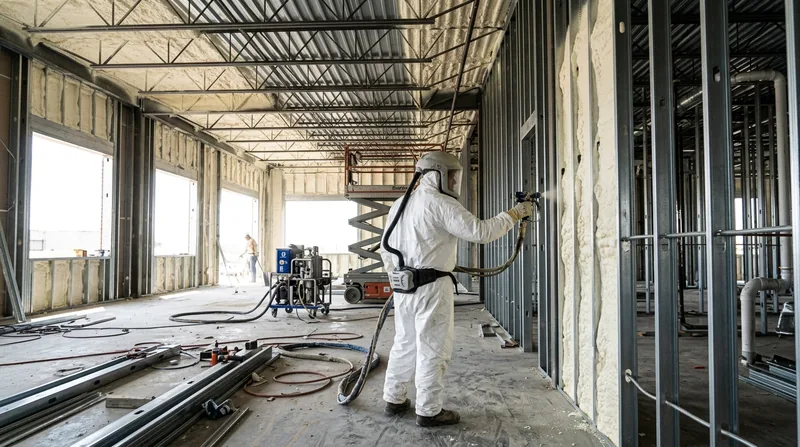




Commercial and new construction spray foam insulation in Davenport seals the building envelope before drywall goes up, locking out the cold winters and humid summers that define Scott County. New commercial builds downtown, in Bettendorf subdivisions, and across Eldridge face the same climate challenge: vapor drives inward during heating season and outward during summer humidity spikes off the Mississippi River. A sealed roof deck and fully sprayed walls stop that movement at the envelope, cut infiltration to near zero, and hold the building tight through its first year of operation and beyond. We spray foam new construction walls and roof assemblies before interior finishes, deliver written estimates with R-value and thickness specs, and work within the permitting and code requirements that apply at your address.
Why Commercial and New Construction Spray Foam Matters in Davenport's Building Climate
New commercial construction in Scott County must perform in a climate that swings from sub-zero winters to hot, humid summers. The Mississippi River valley pushes moisture into every opening, and cold winters drive heating loads that punish any gap in the envelope. Spray foam on new walls and roof decks before drywall closes the building tight, cutting air leakage that fiberglass or mineral wool cannot touch. A properly sealed envelope also lowers HVAC sizing, reduces first-year operational costs, and meets the energy code requirements that apply at your site.
- We spray foam new walls and roof decks to seal the building envelope before interior finishes go up.
- Closed cell foam on roof decks prevents condensation on steel framing during humid summers and cold winters.
- Open cell foam in walls and non-structural cavities delivers R-value without the cost and weight of closed cell.
- Air sealing around electrical, HVAC, and plumbing penetrations stops infiltration that code requires and energy modeling demands.
- Written estimates include R-value, thickness, and coverage area so you know exactly what the contractor is spraying.
A sealed new building starts with the right foam in the right place, specified on plans and verified during installation.
Key info: The Iowa Energy Code and local building departments in Davenport, Bettendorf, and Eldridge govern insulation R-value, thermal barriers, and ignition barriers on new construction. Spray foam must meet the fifteen-minute thermal barrier requirement in walls and attics unless a listed system is used. We help you navigate what applies at your address and defer to the local building official for final approval. See the City of Davenport Building Department for permit requirements at your site.
How We Spray Foam New Commercial Buildings in Davenport
New construction spray foam starts with a site walk and a review of the plans. We identify the walls, roof decks, and rim assemblies that need foam, confirm the foam type and thickness required by code and the energy model, and schedule the spray before drywall or roofing goes up. Our crew arrives with equipment, sprays to the specified thickness in controlled passes, ensures proper ventilation during cure, and leaves the site ready for the next trade. We deliver a written record of what was sprayed, where, and to what thickness and R-value.
- We walk the site with the builder or general contractor and review architectural and energy code documents.
- We confirm the foam type (open cell or closed cell), thickness, and R-value required at each location.
- We schedule the spray for the optimal stage in construction, typically after framing but before drywall or roofing.
- Our crew sets up mechanical ventilation, sprays the foam to the specified thickness in controlled passes, and monitors ratio and temperature.
- We leave the site clean, provide a written record of coverage and R-value, and coordinate with the next trade.
New construction foam is installed once, on schedule, with no surprises. A clear estimate and a written record of what was installed protect both the builder and the building.
Local example: A new retail storefront in downtown Davenport with an unvented roof deck needs closed cell foam to prevent condensation on the steel structure during winter and humid summers. A new office building in Bettendorf with a conditioned attic and sealed roof deck uses open cell foam in the walls to save cost and closed cell on the roof to control moisture at the steel. Each building gets the foam specified on its energy model and approved by the local building department before a single pass is sprayed.
Spray Foam Methods for New Construction
| Approach | Description | Best for |
|---|---|---|
| Closed Cell Roof Deck Foam | High-density foam sprayed to 1.5 to 2 inches on metal or wood roof decks before roofing membrane. | Unvented roof assemblies, condensation control on steel framing, vapor barrier function in humid climates. |
| Open Cell Wall Foam | Low-density foam sprayed to 5.5 or 7 inches in wall cavities before drywall, delivering R-21 or R-29. | Exterior walls, interior partition walls, sound dampening, cost-effective R-value in new framing. |
| Rim and Band Joist Foam | Closed cell or open cell foam sprayed on the rim band between the top of the basement wall and the first floor. | New commercial basements and crawl spaces, sealing the cold thermal bridge where floor meets foundation. |
| Penetration Sealing | Closed cell foam sprayed around electrical, HVAC, plumbing, and structural penetrations to stop air leakage. | All new construction, meeting code air-tightness targets and energy model assumptions. |
Commercial and New Construction Spray Foam Cost in Davenport: What to Expect
New construction spray foam pricing depends on the foam type (open cell or closed cell), the area to be sprayed (walls, roof deck, rim and band joists), site access, and the stage of construction. A free commercial estimate starts with a site walk and a review of the plans so we can specify the right foam and deliver a firm quote. Closed cell foam costs more per board foot than open cell, but it adds vapor barrier function and condensation control on steel, which is critical on roof decks and in humid climates. Open cell foam in walls is less expensive and delivers solid R-value for most new commercial interiors. We provide written estimates with R-value and thickness so you know exactly what you are paying for and what the building will get.
The best way to understand cost is to review our pricing page and then call for a free estimate at (563) 723-0564. We will walk your site, confirm the foam type and coverage, and deliver a number that reflects the actual work. New construction budgets benefit from competitive estimates, so getting two or three quotes from different contractors is smart practice.
What to Look for When Hiring a Spray Foam Contractor Near Davenport
Hiring a spray foam contractor for new construction means verifying insurance, understanding the estimate, and confirming that the contractor knows the code and permitting requirements at your address. A good estimate includes R-value, thickness, and coverage area, not just a price per square foot. The contractor should be able to explain why closed cell is specified on the roof deck and why open cell works in the walls. Ask for references from recent commercial builds in Davenport or Bettendorf, and verify that the contractor has done similar work before.
- Confirm that the contractor is fully insured and can provide a certificate of insurance naming your project.
- Request a written estimate that specifies foam type, R-value, thickness, and coverage area for each location.
- Ask about the contractor's experience with new construction in Scott County and the local building code requirements.
- Verify references from recent commercial projects and confirm that the work was completed on schedule and to specification.
- Understand the contractor's process for mechanical ventilation during cure and the re-entry window before drywall or roofing goes up.
- Confirm that the contractor will coordinate with your general contractor and other trades to keep the schedule on track.
New construction is a team effort, and the spray foam contractor should communicate clearly, deliver on schedule, and leave a clean site. Contact us for a free estimate and let us show you how we work with builders and general contractors across Davenport and Scott County.
Commercial & New Construction Spray Foam in Davenport: Pricing Guide
| Service | Price | Details |
|---|---|---|
| Free commercial estimate | No charge | Site walk, plan review, foam type and R-value specification, written quote with thickness and coverage |
| New construction walls, open cell | Starting at $0.65 per board foot | Exterior and interior walls, 5.5 to 7 inch depth, R-21 to R-29, before drywall installation |
| Roof deck and unvented assemblies, closed cell | Starting at $1.20 per board foot | Metal or wood roof decks, 1.5 to 2 inch depth, vapor barrier and condensation control, before roofing membrane |
| Rim and band joist sealing | Starting at $0.80 per board foot | Closed or open cell foam on basement rim band, basement perimeter, and crawl space headers |
| Penetration sealing and air sealing | Included in wall and roof foam pricing | Electrical, HVAC, plumbing, and structural penetrations sealed to meet code and energy model air-tightness targets |
| Travel and site coordination | Included | Davenport, Bettendorf, Eldridge, and surrounding Scott County areas, no separate mileage or travel charge |
Indicative pricing, the exact cost depends on square footage, finish, and site access. Free personalized estimate within 24h at (563) 723-0564.


