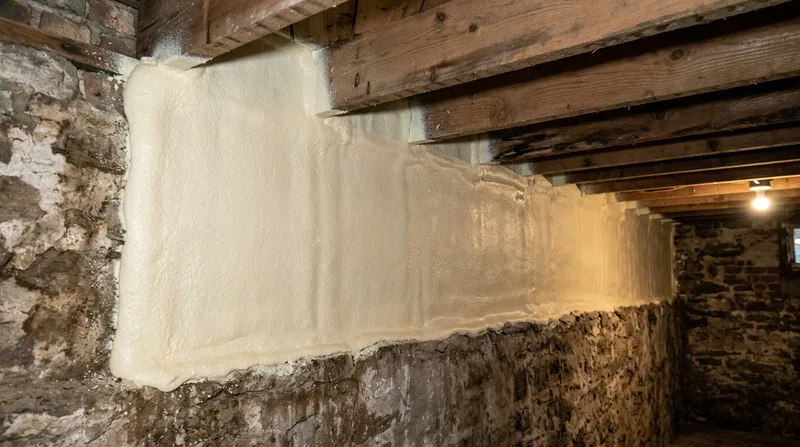




Closed cell spray foam insulation in Davenport adds structural rigidity and moisture resistance to older homes built near the Mississippi River where humidity and temperature swings drive energy loss through walls, attics, and rim joists year-round. The river-valley climate in Scott County brings hot, sticky summers that push moisture into basement walls and crawl spaces, and cold winters that pull vapor outward through uninsulated cavities in balloon-framed houses and postwar ranches. Closed cell foam resists that moisture penetration better than open cell or fiberglass, seals air leaks at the same time, and bonds to rim joists and basement band joists to give older homes structural support they never had. We spray closed cell foam on attics with sealed roof decks, into wall cavities of pre-1980 homes, across basement rim and band joists, and into crawl spaces where humidity control matters as much as R-value. Our work starts with a written estimate that names the R-value, thickness, and board-foot coverage so you know exactly what you are paying for.
Why Closed Cell Foam Matters in Davenport's River-Valley Climate
Davenport's housing stock spans more than a century, and most of it was built without the vapor management that modern building science demands. Nineteenth-century balloon-framed homes in East Davenport and near the river have uninsulated walls that run damp through summer, while postwar ranches scattered across the city carry vented attics with flattened original insulation and cold basement rim joists that sweat in humid weather. Closed cell foam stops air leakage at every penetration, adds R-value per inch (typically R-6 to R-7 per inch), and resists moisture absorption in ways that fiberglass and open cell foam cannot match. In a climate where heating season vapor moves outward through walls and roof assemblies, and summer humidity soaks basement walls and rim joists, closed cell is the material choice that addresses both failure modes at once.
- We seal rim and band joists above older basement walls to stop cold air infiltration and moisture entry during humid river-valley summers.
- We spray closed cell into attics with sealed roof decks to create a continuous air and vapor barrier that prevents condensation on roof sheathing in winter.
- We inject closed cell into wall cavities of pre-1980 homes without demolition, filling voids that fiberglass never reaches and adding structural bracing to balloon-framed walls.
- We apply closed cell to crawl space walls and rim joists to control moisture and prevent the basement dampness that plagues homes near the Mississippi.
Each of these applications stops air leakage and moisture migration at the source, which is why closed cell foam is the standard for older and moisture-prone homes across Davenport and Scott County.
Key info: A 1920s home in East Davenport with balloon-framed walls and a vented attic typically loses heat through uninsulated rim joists and air leaks at the top plate. Closed cell foam seals both at the same time, stops moisture from wicking into the rim cavity, and adds rigidity to walls that have settled over a century. The cost is higher than fiberglass, but the performance difference is measurable in heating bills and basement humidity.
For more detail on how we approach attic work, see our attic spray foam insulation page.
How We Install Closed Cell Spray Foam: The Davenport Approach
Closed cell foam is applied in layers, typically two to three passes of half-inch or three-quarter-inch foam per pass, depending on the R-value target and the substrate. The process requires controlled drum temperature, proper pump ratio, and mechanical ventilation during cure to manage VOC off-gassing. We do not spray over wet, contaminated, or actively leaking substrates; we fix the moisture source first or we walk away. Once cured, closed cell is low-VOC and meets code, but the installation itself demands precision and the homeowner must stay out of the space for twenty-four to forty-eight hours while cure completes.
- We inspect the substrate, identify air leaks and moisture sources, and document what we see in the written estimate.
- We prepare the space by removing old insulation if needed, sealing large gaps, and setting up mechanical ventilation for the cure period.
- We spray closed cell in controlled passes, measuring thickness and board-foot coverage on site so the final R-value matches the estimate.
- We allow full cure time before re-entry and provide written documentation of the coverage, thickness, and R-value achieved.
This step-by-step approach is how we deliver a repeatable result that holds up over time and meets local building code.
Local example: A Bettendorf two-story home with a sealed attic and hot upstairs rooms benefits from closed cell foam sprayed on the roof deck to R-30 or R-38, which air-seals the roof penetrations and ridge vent, stops temperature stratification, and drops the upstairs cooling load. A Davenport postwar ranch with a cold basement rim joist gets two inches of closed cell applied to the band joist and rim cavity above the foundation wall, which is R-12 to R-14 and stops the cold draft that runs across the basement floor in January.
For a deeper look at our approach to wall insulation and retrofit work, see wall and injection foam insulation.
| Approach | Description | Best for |
|---|---|---|
| Sealed attic with roof deck spray | Two to three inches of closed cell applied directly to roof sheathing, air-sealing all penetrations and ridge vents. | Homes with hot upstairs rooms, attic HVAC equipment, or ducting that needs conditioned space protection. |
| Rim and band joist insulation | One to two inches of closed cell applied to the band joist cavity and rim above the foundation wall. | Older homes with cold basements, postwar ranches with rim leakage, and any basement with humidity or drafts at floor level. |
| Wall cavity injection | Closed cell foam injected into existing wall cavities through holes drilled on exterior or interior, filling voids without demolition. | Balloon-framed and pre-1980 homes where wall cavities are uninsulated and demolition is not an option. |
| Crawl space wall and rim | Closed cell applied to crawl space walls and rim joists to control moisture and prevent condensation on floor joists. | Homes with damp crawl spaces, homes near the Mississippi where humidity is year-round, and any crawl space with mold or moisture history. |
Closed Cell Spray Foam Insulation Cost in Davenport: What to Expect
Closed cell spray foam in Davenport typically starts at around $1.20 per board foot, with the final cost determined by the thickness needed to reach your R-value target, the square footage of the space, substrate condition, and site access. A rim and band joist job on a postwar ranch might run $800 to $1,500 for two inches across a 600-square-foot basement perimeter. A sealed attic on a two-story Bettendorf home with 1,200 square feet of roof deck and an R-38 target (three to four inches of closed cell) can range from $4,500 to $7,200 depending on access, existing insulation removal, and the number of penetrations to seal. Wall injection into a 1920s Davenport home with uninsulated cavities across 800 square feet of wall area typically costs $2,400 to $4,000 for two inches of foam filling voids and adding structural bracing.
The variables that move cost are substrate preparation (old insulation removal, moisture repair, air sealing before spray), thickness and R-value target, board-foot volume, site access for the spray rig, and whether mechanical ventilation or temporary enclosure is needed during cure. We provide a written estimate that breaks down the board-foot count, thickness per pass, R-value achieved, and total cost before any work begins. Getting two to three estimates from different contractors is the smart move because spray foam technique and material costs vary, and a low bid without thickness specs or R-value documentation is a red flag.
For a full breakdown of pricing across all our services, see our pricing page.
What to Look for When Hiring a Spray Foam Insulation Contractor Near Davenport
The spray foam industry includes honest local shops, national franchises, and rig-and-run crews that spray a job in an afternoon and are unreachable when the smell will not go away or the cure went wrong. When you are comparing contractors near Davenport, Bettendorf, Eldridge, or any of the surrounding towns, ask for a written estimate that names the R-value, thickness in inches, and board-foot coverage. Verify that the contractor carries full insurance and ask to see the certificate. Check references from similar jobs in your area, ask how long they have been in business, and confirm that they understand the local building code for your city or township. Permits and registration vary from city to city across Greater Davenport, so ask which permits apply at your address and whether the contractor will help you navigate what your building department requires.
- Request a written estimate with R-value, thickness, and board-foot count before any work begins, never a price per square foot without those details.
- Verify that the contractor is fully insured and ask for proof of coverage that names spray foam work and your address as the job site.
- Ask about the cure time, mechanical ventilation during application, and the re-entry window so you know when your space is safe to use again.
- Confirm that the contractor will not spray over wet, contaminated, or actively leaking substrates and will address moisture issues before foam is applied.
- Check references from at least two recent jobs in Davenport or nearby towns and ask specifically about noise, smell, cleanup, and how long the cure took.
These steps separate the contractors who do the work right from those who cut corners, and they protect you from a costly mistake.
Ready to move forward? Contact us for a free, no-obligation estimate, or call (563) 723-0564 to discuss your project with someone who knows Davenport's housing stock and climate firsthand.
Closed Cell Spray Foam Insulation in Davenport: Pricing Guide
| Service | Price | Details |
|---|---|---|
| Rim and band joist insulation | Starting at $1.20/board ft | Two-inch closed cell application to basement rim cavity, cost varies with linear feet of rim and basement access |
| Sealed attic with roof deck spray | Starting at $1.20/board ft | Three to four inches of closed cell to achieve R-38 or higher, final cost depends on attic square footage and penetration complexity |
| Wall cavity injection retrofit | Starting at $1.20/board ft | Closed cell injected into existing wall cavities of older homes, pricing reflects cavity depth, wall area, and hole drilling access |
| Crawl space wall and rim application | Starting at $1.20/board ft | Moisture control on crawl space walls and rim joists, cost depends on linear feet of wall and existing moisture or debris removal |
| Complex or large-scale job | On estimate | Jobs combining multiple areas, substrate prep, or structural repair need an on-site inspection before pricing is final |
| Estimate and travel | Free | No charge for written estimate in Davenport and surrounding service areas, response within 24 hours at (563) 723-0564 |
Indicative pricing, the exact cost depends on square footage, finish, and site access. Free personalized estimate within 24h at (563) 723-0564.


