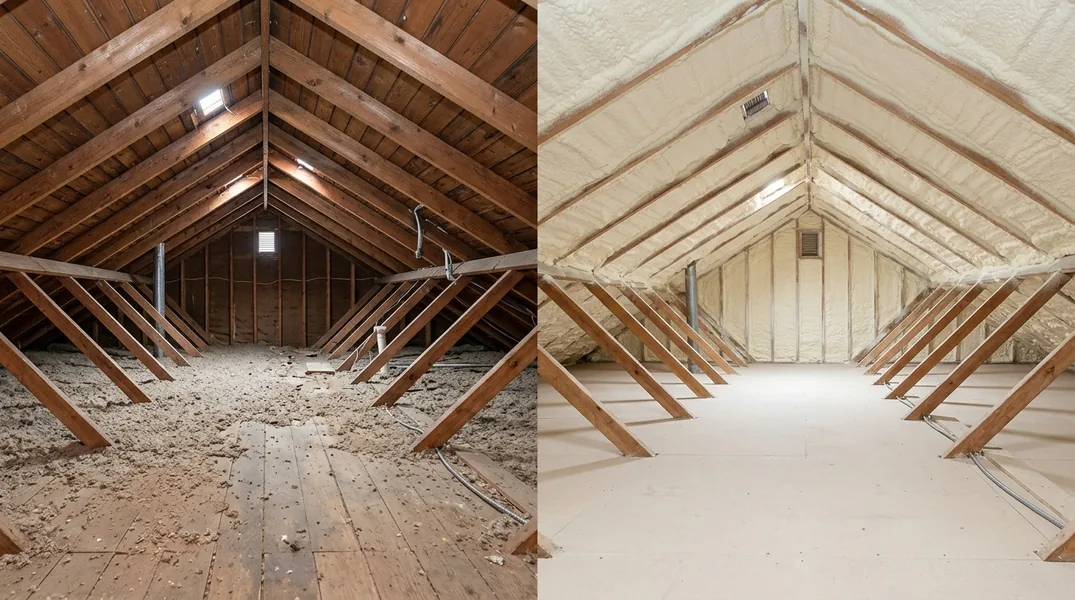
Understanding Balloon-Framed Walls and Their Insulation Challenges
Homes in the Village of East Davenport built before the 1970s often feature balloon framing, a construction method that creates unique insulation challenges. In balloon-framed walls, studs run continuously from the foundation to the roof line without the horizontal fire blocks found in modern platform framing. This continuous cavity creates a direct pathway for air infiltration and heat loss, making these older homes significantly less energy-efficient than their contemporary counterparts.
The problem becomes even more acute when you consider that traditional fiberglass batts and blown-in cellulose cannot effectively seal these large, uninterrupted cavities. Air leaks around gaps, cracks, and the edges of traditional insulation allow conditioned air to escape, forcing your heating and cooling systems to work harder. Homeowners in Davenport with balloon-framed construction often report cold spots, drafty rooms, and higher-than-expected utility bills, especially during winter months.
Why Spray Foam Insulation Works for Balloon-Framed Walls
Attic Spray Foam Insulation and Wall & Injection Foam Insulation offer a superior solution for balloon-framed homes because the material expands to fill every cavity and gap. Unlike batts that compress over time or blown-in materials that settle, spray foam creates an air-tight seal that conforms to irregular spaces, wall cavities, and structural imperfections. This comprehensive coverage is particularly valuable in balloon-framed construction, where the continuous vertical cavities can otherwise become superhighways for unwanted air movement.
The expansion characteristic of spray foam means that once applied, it hardens into a solid barrier that prevents both convective air movement and radiant heat transfer. For homeowners dealing with the thermal inefficiency of balloon-framed walls, this translates to noticeably warmer rooms in winter, cooler spaces in summer, and measurable reductions in energy consumption. The material also provides structural reinforcement to walls, which can be an added benefit in older homes where framing integrity may have deteriorated over decades.
Is Spray Foam Insulation Worth It for Your East Davenport Home
Whether spray foam insulation is worth it depends on several factors specific to your home and situation. For balloon-framed homes, the answer is often yes, especially if you are experiencing energy efficiency problems, drafty conditions, or rising heating and cooling costs. The long-term energy savings can be substantial. Many homeowners report 20 to 30 percent reductions in utility bills after spray foam insulation is properly installed in previously under-insulated walls and attics. Over a 15 to 20-year period, these savings can easily exceed the initial investment.
Beyond energy savings, spray foam provides moisture control, air sealing, and improved indoor air quality by reducing dust infiltration. For older homes in East Davenport, these non-energy benefits are equally important. If you plan to stay in your home long-term, the combination of comfort improvements, lower operating costs, and increased property value often justifies the upfront expense. However, it is important to understand both the advantages and potential drawbacks before committing. Getting a free estimate from Davenport Spray Foam Insulation will help you understand the specific return on investment for your property.
Spray Foam Insulation Safety and Off-Gassing Concerns
Safety is a legitimate concern when considering spray foam, and homeowners often ask: is spray foam insulation safe? The answer is yes when installed by qualified professionals, but understanding the risks and proper installation protocols is essential. During the application process, spray foam releases volatile organic compounds (VOCs) and isocyanates, which can be harmful if inhaled. This is why professional installers wear protective equipment and ensure proper ventilation during application. Once fully cured, properly installed spray foam poses no health risk to occupants.
Spray foam off-gassing is a common concern among homeowners researching this insulation method. Off-gassing refers to the release of chemical odors and fumes after installation. Most quality spray foam products off-gas for 24 to 48 hours after application. During this period, it is advisable to open windows and increase ventilation. After this initial curing period, off-gassing is minimal. The choice between Closed Cell Spray Foam Insulation and Open Cell Spray Foam Insulation can also affect off-gassing intensity. Closed cell foam typically off-gasses less than open cell, though both are safe once fully cured. Professional installers at Davenport Spray Foam Insulation follow industry best practices to minimize off-gassing and ensure your home is safe for reoccupancy.
Spray Foam Insulation Problems and Pros and Cons
No insulation material is perfect, and spray foam insulation problems do exist. Common issues include improper installation leading to incomplete coverage, moisture trapping if applied over wet surfaces, and potential shrinkage if the product is not mixed correctly. Additionally, spray foam can be difficult or impossible to remove if future renovations are needed, and some building codes in certain jurisdictions have specific requirements for its use. Understanding these limitations helps you make an informed decision about whether spray foam is the right choice for your balloon-framed home.
When weighing spray foam insulation pros and cons, the advantages typically outweigh the drawbacks for most homeowners. On the positive side, spray foam offers superior air sealing, excellent R-value per inch, moisture resistance, and long-term durability. It also provides structural support and can reduce noise infiltration. The cons include higher upfront cost compared to traditional insulation, the need for professional installation, off-gassing during curing, and potential difficulty with future modifications. For balloon-framed homes in East Davenport where energy efficiency is a major concern, the pros generally justify the investment. The key is working with experienced, insured installers who understand your specific home's needs and can address potential issues before they arise.
Spray Foam Insulation Cost in Davenport: What to Budget
Understanding spray foam insulation pricing is crucial for homeowners planning this investment. Spray foam typically costs between $1.00 and $2.50 per board foot, depending on the type (open cell or closed cell), thickness, and complexity of the project. For a typical balloon-framed wall cavity in a Davenport home, you might expect to invest $2,000 to $8,000 for comprehensive wall insulation, with attic work ranging from $1,500 to $5,000 depending on square footage. While these figures are higher than traditional insulation materials, remember that spray foam delivers superior performance and long-term savings that often offset the initial expense within 5 to 10 years.
Several factors influence the final cost of your spray foam project. The square footage of the area to be insulated, the R-value required, accessibility of the work area, and whether existing insulation must be removed all impact the total investment. Closed cell foam costs more than open cell but provides higher R-value and better moisture resistance, making it ideal for balloon-framed walls. Rather than estimating costs on your own, contact Davenport Spray Foam Insulation at (563) 723-0564 to discuss your specific project and receive a detailed, customized quote. A professional assessment of your balloon-framed home will reveal exactly what you need and what you can expect to invest.
Looking for a professional spray foam insulation contractor in Davenport? Davenport Spray Foam Insulation responds fast for all your spray foam insulation needs.
Get a Free Quote