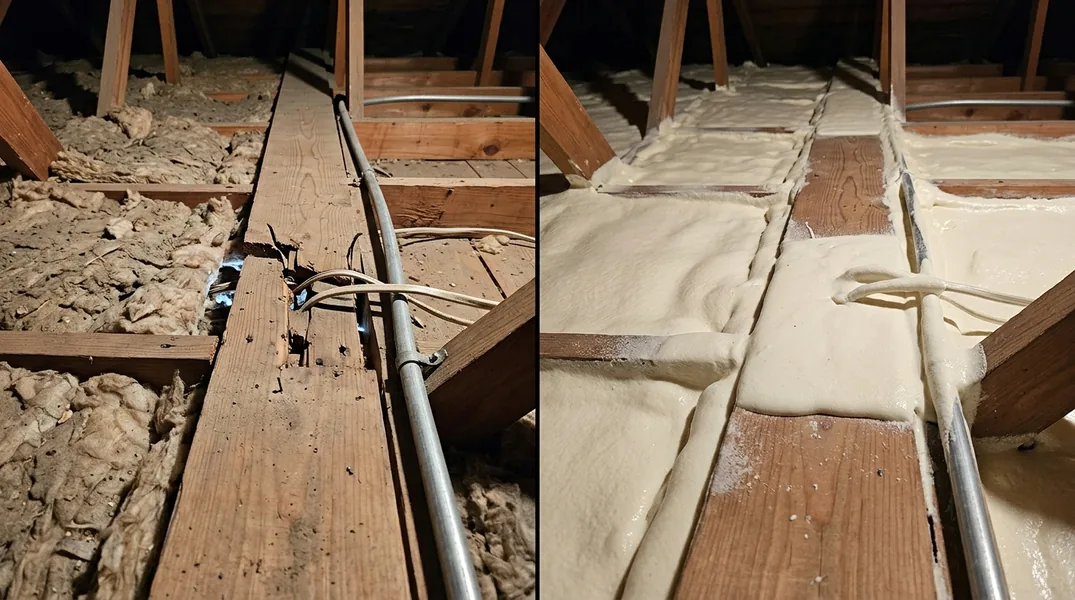
Understanding the Difference Between Air Sealing and Spray Foam
When homeowners in Eldridge start researching attic insulation solutions, they often encounter two distinct approaches: air sealing and full spray foam installation. While these methods are sometimes presented as competitors, they actually work best when understood as complementary strategies. Air sealing focuses on identifying and closing gaps, cracks, and penetrations in your attic where conditioned air escapes. This might include sealing around ductwork, electrical outlets, pipe penetrations, and structural gaps. Full Attic Spray Foam Insulation, by contrast, provides both thermal resistance and air sealing in one application by expanding polyurethane foam that fills cavities and hardens into a solid barrier.
The key distinction lies in performance scope and longevity. Air sealing alone reduces air infiltration but doesn't add significant insulation value. You might use caulk, weatherstripping, or foam sealant to close gaps, but you're still relying on your existing insulation's R-value to handle thermal resistance. Spray foam, whether Closed Cell Spray Foam Insulation or Open Cell Spray Foam Insulation, simultaneously seals air leaks and provides insulation. This dual functionality is why many homeowners in Davenport area communities are turning to spray foam as a comprehensive solution.
Spray Foam Insulation R Value Per Inch: What You Need to Know
One of the most important metrics when evaluating insulation options is the spray foam insulation R value per inch. R-value measures thermal resistance, and higher R-values indicate better insulating performance. Closed cell spray foam typically delivers 6.0 to 7.0 R-value per inch, making it one of the most efficient insulation materials available. Open cell spray foam provides approximately 3.5 to 3.6 R-value per inch, which is still respectable but requires greater thickness to achieve equivalent thermal performance.
For homeowners deciding between air sealing and full spray foam, this R-value difference matters significantly. If you only air seal without adding insulation, you're not improving your home's thermal resistance at all. You're simply preventing conditioned air from escaping through gaps. Spray foam, however, addresses both problems simultaneously. A 4-inch application of closed cell foam delivers roughly 24 to 28 R-value, while the same thickness of open cell provides around 14 R-value. Understanding these numbers helps explain why spray foam often outperforms traditional insulation plus air sealing in terms of overall energy efficiency and comfort.
R Value Requirements by State: Iowa's Standards and Your Attic
Iowa has specific energy code requirements that dictate minimum R-value requirements by state for attic insulation. The current Iowa Energy Code recommends R-38 to R-49 for attic insulation, depending on your specific climate zone within the state. Eldridge homeowners should aim for at least R-38, though many experts recommend R-49 for optimal year-round comfort and energy savings. These standards exist because inadequate insulation forces your HVAC system to work harder, increasing utility costs and reducing equipment lifespan.
When you're deciding between air sealing alone versus spray foam, it's crucial to know whether your current attic insulation meets these state requirements. Many older homes in the Davenport area were built with R-19 or R-25 insulation, which falls well short of current standards. Air sealing those inadequate layers won't bring you into compliance. Spray foam, however, can efficiently bring your attic up to code in a single application. A 6-inch layer of closed cell spray foam exceeds Iowa's R-49 requirement, while open cell foam would need about 14 inches to achieve the same performance. This is why understanding both your current insulation level and state requirements is essential before making your decision.
How Thick Should Spray Foam Be: Finding the Right Depth for Your Home
The question of how thick should spray foam be depends on several factors including your current insulation, your climate zone, and your energy efficiency goals. There's no one-size-fits-all answer, but Iowa's energy code provides a helpful starting point. To meet the R-38 minimum, you'd need approximately 5.5 inches of closed cell spray foam or roughly 11 inches of open cell foam. To achieve the R-49 recommendation, plan on 7 inches of closed cell or about 14 inches of open cell.
Beyond meeting code, your contractor should also assess your attic's structural capacity and ventilation needs. Spray foam application thickness is limited by joist depth and rafter spacing. Most residential attics have joists between 6 and 12 inches deep, which naturally constrains foam thickness. Some homeowners opt for a hybrid approach: applying closed cell foam to the roof deck (which provides superior air sealing and moisture control) and then adding open cell foam or traditional batts to reach desired R-values. This strategy often proves more cost-effective than filling the entire cavity with closed cell foam. When you're ready to determine the ideal thickness for your specific situation, getting a free estimate from a local professional allows you to see your options clearly.
Insulation Tax Credit and Rebates: Financial Incentives for Spray Foam
One compelling reason to choose spray foam insulation over simple air sealing is the availability of financial incentives. The federal insulation tax credit has made spray foam upgrades more affordable for many homeowners. Depending on current regulations and your income level, you may qualify for up to 30% of insulation installation costs as a tax credit, capped at $1,200 per year. Many states and local utilities also offer insulation rebates that can further reduce your out-of-pocket expenses. These incentives recognize that home insulation improvements reduce energy consumption and lower greenhouse gas emissions, benefiting everyone.
When budgeting for your attic insulation project, don't overlook these financial opportunities. Air sealing alone may not qualify for certain rebates, but comprehensive insulation upgrades like spray foam installation often do. Before making your decision, contact Davenport Spray Foam Insulation at (563) 723-0564 to discuss which incentives you might qualify for and how they apply to your project. Many homeowners are surprised to learn that after applying available tax credits and rebates, spray foam becomes surprisingly competitive with traditional insulation methods in terms of net cost, while delivering superior performance and durability.
Attic Spray Foam Insulation Cost in Davenport: What to Budget
Understanding the pricing for spray foam insulation helps you make an informed comparison with air sealing costs. Closed cell spray foam typically ranges from $1.00 to $1.50 per board foot installed, while open cell foam costs roughly $0.50 to $0.75 per board foot. For a typical 1,500 square foot attic requiring 6 inches of closed cell foam, you might expect costs between $4,500 and $6,750. Open cell foam for the same space would run approximately $2,250 to $3,375. Air sealing alone is considerably cheaper, often ranging from $500 to $1,500 for a complete attic, but it doesn't add insulation value or address thermal resistance shortfalls.
When comparing total cost of ownership, remember that spray foam lasts 50+ years without settling or degrading, while traditional batts may need replacement within 20 to 30 years. Spray foam also reduces energy consumption immediately, lowering monthly utility bills. Many homeowners in the Davenport area find that energy savings, combined with tax credits and rebates, recover their spray foam investment within 5 to 10 years. Air sealing provides no energy savings on its own and therefore offers no payback period. If your attic insulation is already adequate and you simply have air leaks, air sealing alone makes sense. But if your insulation is below code or you want maximum efficiency, spray foam delivers superior long-term value. Contact us today at (563) 723-0564 or request a free estimate to compare your specific options and costs.
Looking for a professional spray foam insulation contractor in Davenport? Davenport Spray Foam Insulation responds fast for all your spray foam insulation needs.
Get a Free Quote